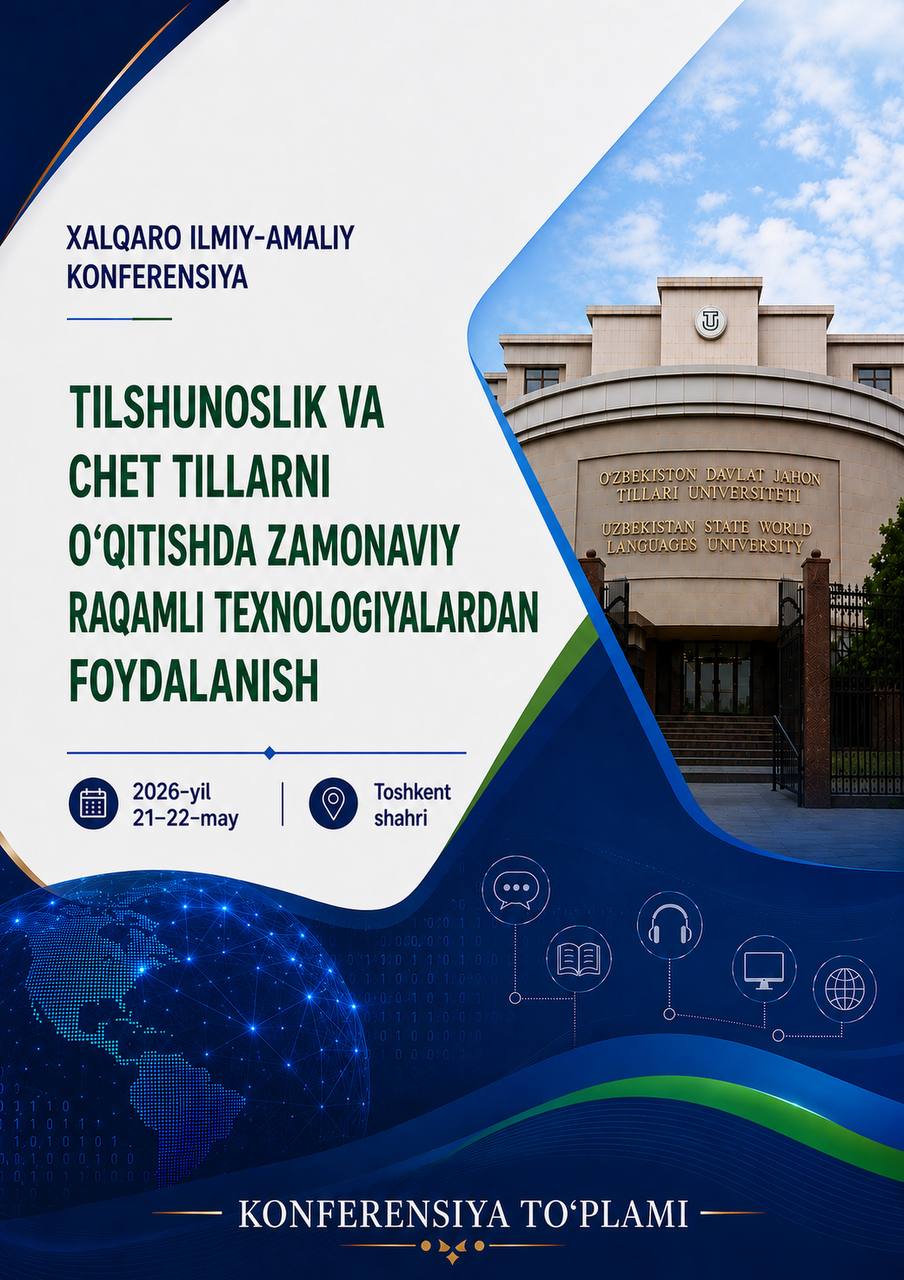
THE ROLE OF DIGITAL TECHNOLOGIES AND INNOVATIVE METHODS IN IMPROVING STUDENT ENGAGEMENT AND EFFECTIVENESS IN ENGLISH LANGUAGE LEARNING
https://doi.org/10.5281/zenodo.20377715
Kalit so‘zlar
digital learning, English teaching, student participation, learning outcomes, artificial intelligence, innovationAnnotasiya
This paper explores how the use of modern technologies and innovative approaches in English language teaching influences student participation and learning outcomes. Based on recent research and practical examples, it demonstrates that digital platforms, artificial intelligence, and interactive tools are reshaping traditional teaching methods. The study reveals that these technologies can increase learners’ motivation, involvement, and academic success. At the same time, it also considers challenges such as unequal access to technology and the need for teacher training.
Foydalanilgan adabiyotlar ro‘yhati
Richard E. Mayer (2009). Multimedia Learning (2nd ed.). Cambridge University Press. https://www.cambridge.org/core/books/multimedia-learning/
Rod Ellis (2015). Understanding Second Language Acquisition (2nd ed.). Oxford University Press.
https://global.oup.com/academic/product/understanding-second-language-acquisition-9780194422048
UNESCO (2021). AI and Education: Guidance for Policy-makers.
https://unesdoc.unesco.org/ark:/48223/pf0000376709
Neil Selwyn (2016). Education and Technology: Key Issues and Debates.
Link: https://www.bloomsbury.com/uk/education-and-technology-9781472588517/
OECD (2020). Education in the Digital Age. https://www.oecd.org/education/
Hayo Reinders & Philip Hubbard (2013). CALL and Learner Autonomy.
https://www.cambridge.org/core/books/call-and-learner-autonomy/
World Bank (2020). The COVID-19 Pandemic: Shocks to Education and Policy Responses. https://www.worldbank.org/en/topic/education
Mark Warschauer (2004). Technology and Social Inclusion: Rethinking the Digital Divide. https://mitpress.mit.edu/9780262731737/technology-and-social-inclusion/