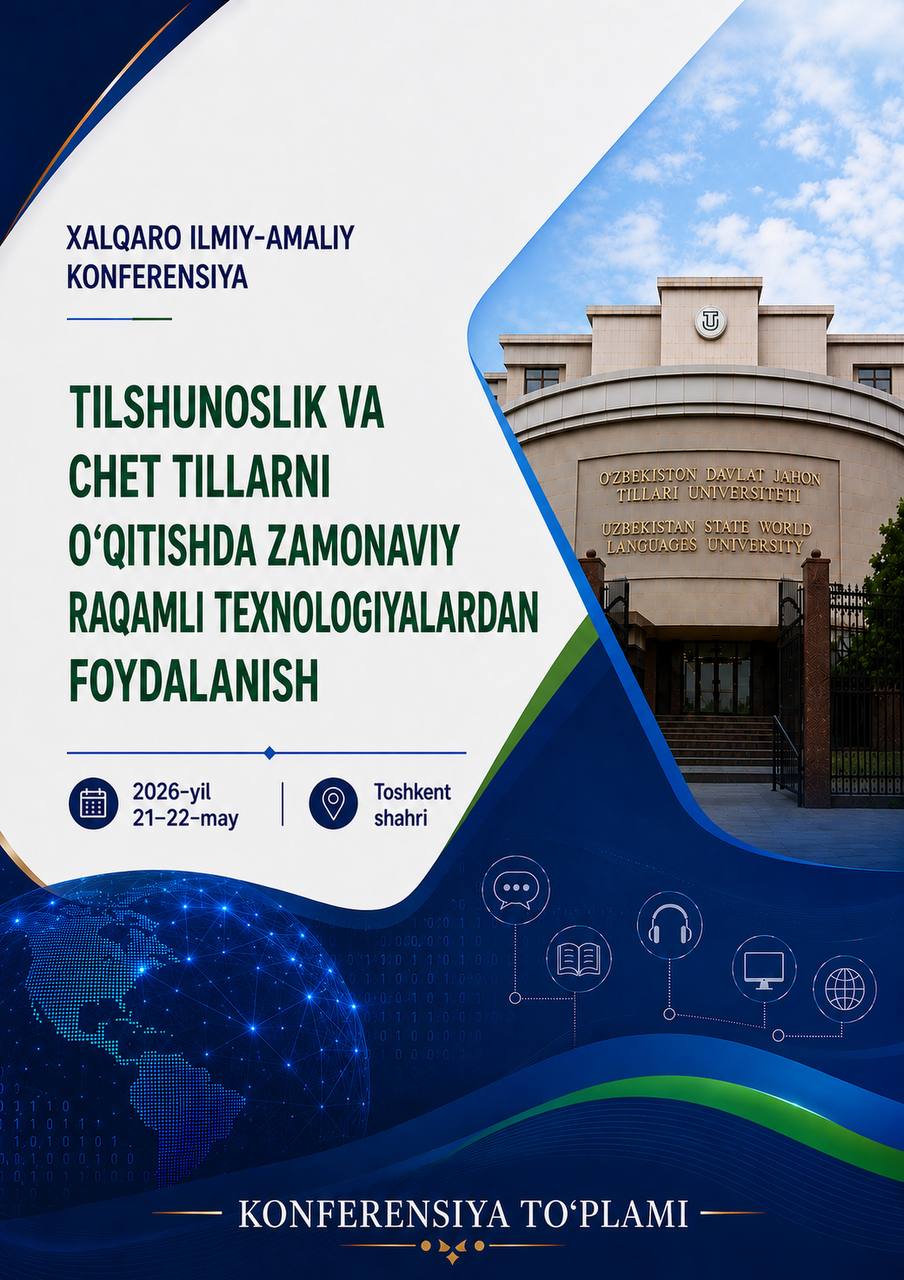
DIDACTIC POSSIBILITIES OF DIGITAL EDUCATIONAL PLATFORMS AND INTERACTIVE METHODS IN TEACHING FOREIGN LANGUAGES THE PROBLEMS OF TEACHING ENGLISH VOCABULARY
https://doi.org/10.5281/zenodo.20377412
Kalit so‘zlar
Digital educational platforms, Interactive methods, Learning Management Systems (LMS), Microsoft Teams, decontextualization, multimodality, TBLT, Gamified learning, GTM.Annotasiya
This article investigates possible difficulties of teaching English vocabulary, adapting interactive vocabulary teaching methods in classroom and applying different digital educational platforms. It highlights the root of the problems which teachers face today in the process of teaching vocabulary such as decontextualization, limitations of the Grammar Translation Method and the appropriate ways to solve them. The study explores how interactive strategies, including Task-Based Language Teaching (TBLT) and gamification, shift the classroom focus from teacher-oriented to student-centered.
Foydalanilgan adabiyotlar ro‘yhati
Dina, N., & Beisenbayeva, L. Z. (2025). Modern interactive methods of teaching English vocabulary to students of non-linguistic universities. Scientific Research and Experimental Development, (9). https://ojs.scipub.de/index.php/SRED/article/view/5467
Indonesian Journal of Pedagogy and Teacher Education. (2025). The use of the interactive learning platform Quizizz in enhancing vocabulary acquisition in English language teaching: A literature review study. Indonesian Journal of Pedagogy and Teacher Education, 3(3).
Kahoot! (2026). Game-based learning platform for engagement and review. https://kahoot.com
Loor Gómez, S. K., & Vivero Cedeño, N. J. (2025). Playful learning game to improve vocabulary acquisition in the English language. Reincisol, 4(7), 702–717. https://doi.org/10.59282/reincisol.v4(7)702-717
Mayer, R. E. (2001). Multimedia learning. Cambridge University Press.
Memrise. (2026). Adaptive learning and spaced repetition in vocabulary acquisition. https://www.memrise.com
Treve, M. (2024). Comparative analysis of teacher-centered and student-centered learning in the context of higher education: A co-word analysis. Iberoamerican Journal of Science Measurement and Communication, 4(2), 1–12. https://doi.org/10.47909/ijsmc.117
UNESCO. (2026). Online education platforms. https://www.unesco.org/en/query-list/o/online-education-platforms
Zeng, Y., Kuo, L.-J., Chen, L., Lin, J.-A., & Shen, H. (2025). Vocabulary instruction for English learners: A systematic review connecting theories, research, and practices. Education Sciences, 15(3), 262. https://doi.org/10.3390/educsci15030262