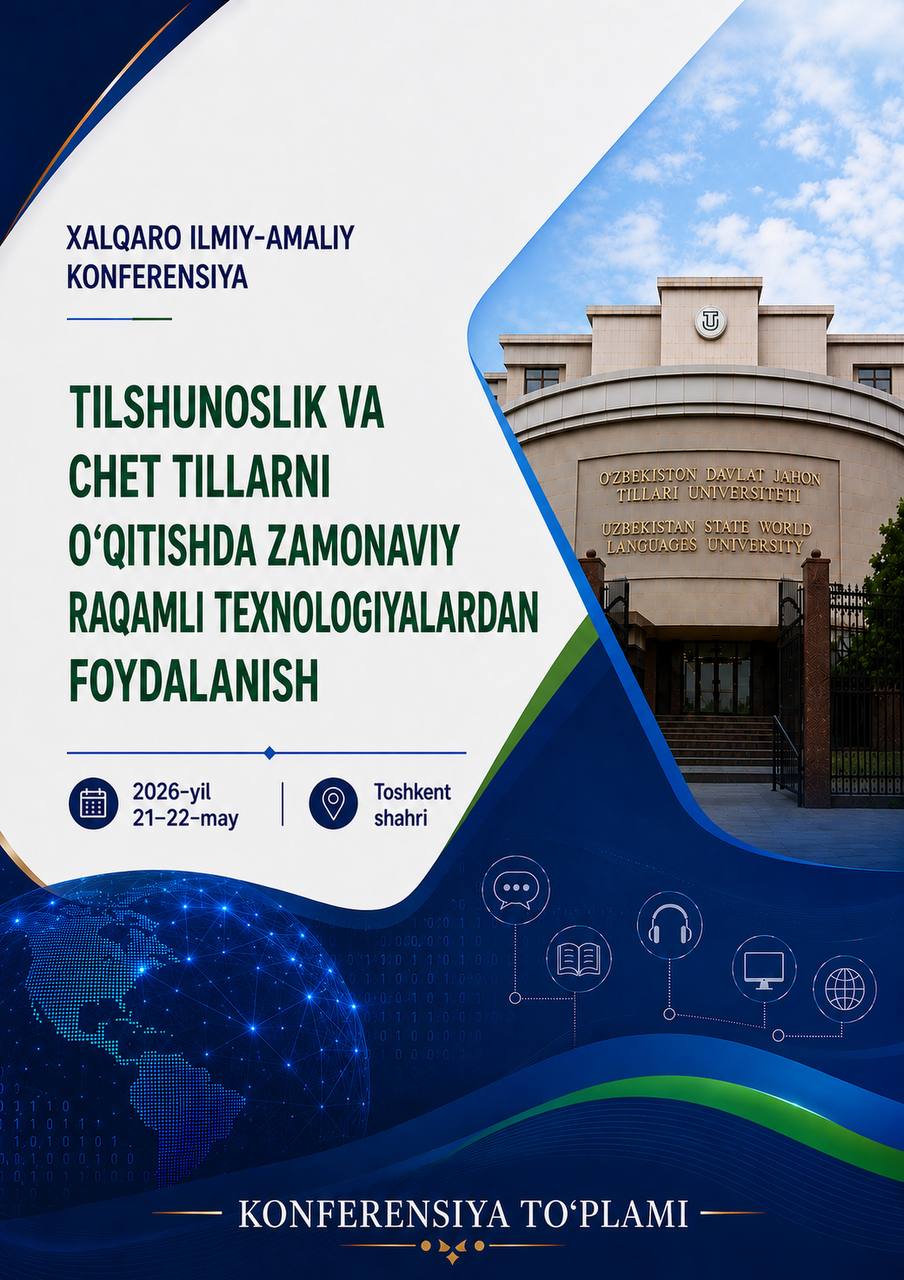
THE DIDACTIC POTENTIAL OF DIGITAL EDUCATIONAL PLATFORMS AND INTERACTIVE METHODS IN FOREIGN LANGUAGE TEACHING
https://doi.org/10.5281/zenodo.20589115
Kalit so‘zlar
digital learning, foreign language teaching, interactive methods, student engagementAnnotasiya
In today’s rapidly changing educational environment, digital technologies have become more than just tools — they have become a part of students’ daily learning experience. This article explores the didactic potential of digital educational platforms and interactive teaching methods in foreign language learning. Based on qualitative analysis and practical observations, the study highlights how digital tools such as mobile applications, online platforms, and virtual classrooms influence students’ motivation, engagement, and overall language development. The findings show that while these technologies make learning more accessible and engaging, they also raise concerns about overdependence and reduced critical thinking. Therefore, a balanced and conscious use of digital tools is essential for effective language education.
Foydalanilgan adabiyotlar ro‘yhati
Godwin-Jones, R. (2018). Emerging technologies and language learning. Language Learning & Technology, 22(3), 1–15.
Warschauer, M. (2010). New tools for teaching writing. Language Learning & Technology, 14(1), 3–8.
Stockwell, G. (2013). Mobile-assisted language learning. In C. A. Chapelle (Ed.), The encyclopedia of applied linguistics. Wiley-Blackwell.
Richards, J. C. (2015). Key issues in language teaching. Cambridge University Press.
Kukulska-Hulme, A., & Shield, L. (2008). An overview of mobile assisted language learning. ReCALL, 20(3), 271–289.
Chapelle, C. A. (2001). Computer applications in second language acquisition. Cambridge University Press.