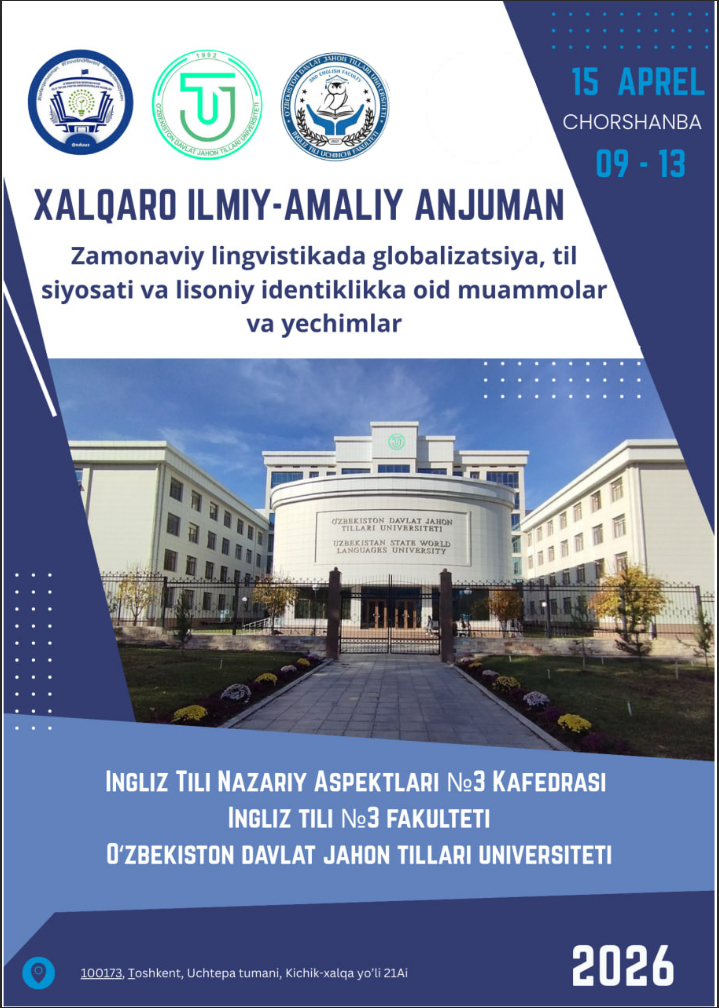
GLOBALIZATION, LANGUAGE POLICY AND LINGUISTIC IDENTITY IN MODERN LINGUISTICS: PROBLEMS AND SOLUTIONS
https://doi.org/10.5281/zenodo.20007139
Kalit so‘zlar
globalization, language policy, linguistic identity, multilingualism, cultureAnnotasiya
This paper discusses the impact of globalization on language, language policy, and linguistic identity in modern linguistics. Globalization has increased communication between people from different countries, but it has also created challenges for local languages. The spread of global languages, especially English, can lead to the decline of smaller languages and cultural loss. The study also examines problems in language policy, such as inequality between dominant and minority languages. In addition, the paper explores the concept of linguistic identity and how it is affected by social and cultural changes.
Finally, several possible solutions are suggested. These include supporting local languages through education, promoting multilingualism, and creating fair language policies. The paper concludes that a balance between global communication and cultural preservation is necessary.
Foydalanilgan adabiyotlar ro‘yhati
Bourdieu, P. Language and Symbolic Power. Cambridge: Polity Press, 1991.
Butler, J. Excitable Speech: A Politics of the Performative. New York: Routledge, 1997.
Froese, P. “After Atheism: An Analysis of Religious Monopolies in the Post-Communist World.” Sociology of Religion, 2004.
Jay, T. “The Utility and Ubiquity of Taboo Words.” Perspectives on Psychological Science, 2009.
Zhuravlev, V. P. Русская ненормативная лексика: социальные и культурные функции. Москва, 2004.
Humboldt, W. von. Избранные труды по языкознанию. Москва, 1984.
Austin, J. L. How to Do Things with Words. Oxford: Oxford University Press, 1962.
G‘ulomova, M. “O‘zbek tilida etnopedagogik birliklarning pragmatik xususiyatlari.” Toshkent, 2023.
Crystal, D. The Cambridge Encyclopedia of the English Language. Cambridge, 2003.
Fairclough, N. Language and Power. London: Longman, 1989.